Outgroup Homogeneity Bias
Category: Social
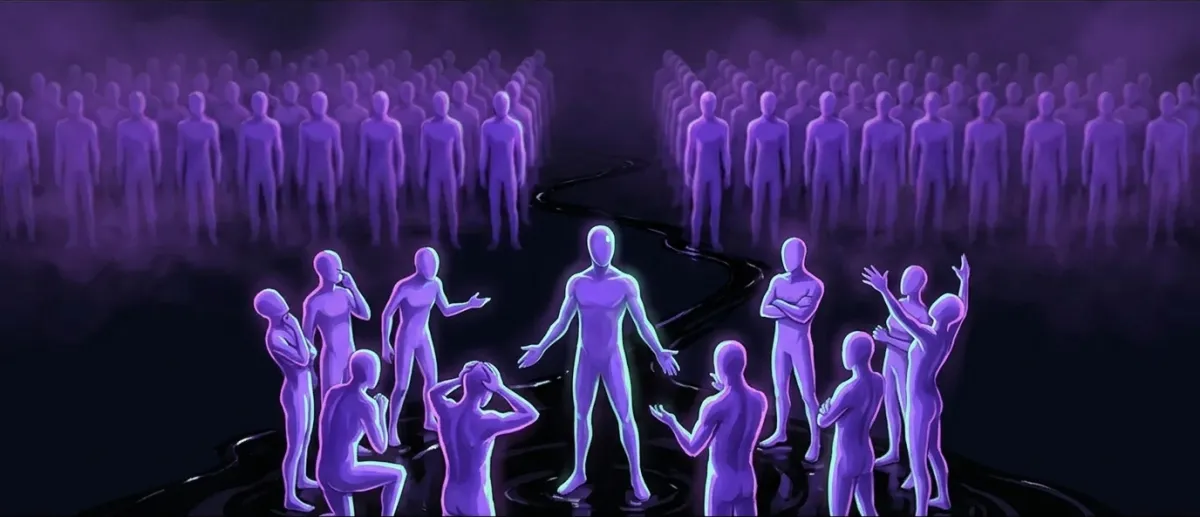
You see your own group as full of distinct individuals and the other group as a blur of interchangeable copies. "We" are diverse; "they" are all the same.
How it works
The bias runs on an information imbalance baked into how you store people. You accumulate rich, individuating memories of your own group (their quirks, exceptions, and range) while the outgroup gets filed under a single category label with a few traits attached, so their internal variety literally never gets encoded. Because you can retrieve dozens of distinct ingroup exemplars and only a stereotype for the outgroup, your brain concludes "they" are more uniform than "we" are, when really you just know them worse. Categorization does the rest: once someone is tagged "one of them," you process them at the group level instead of the individual level, which is exactly why people are about 1.56 times more likely to falsely identify a novel other-race face than an own-race one (Meissner and Brigham, 2001). This is the raw material of stereotypes, because a group you perceive as homogeneous is a group you can dismiss, generalize about, and dehumanize in one move.
Where you'll see it
- The founding study: Quattrone and Jones (1980) had members of rival Princeton eating clubs and of rival universities rate how much group members differed from each other. People consistently saw more variability inside their own group and treated the outgroup as a single type. In a companion political study, supporters of one 1976 presidential candidate heard a single opinion and assumed a far higher percentage of the opposing camp shared it than of their own.
- Faces: the cross-race effect ('they all look alike to me') is outgroup homogeneity at the perceptual level. Meissner and Brigham's (2001) meta-analysis of nearly 5,000 participants found people are roughly 1.56 times more likely to falsely identify a novel other-race face than an own-race one, a direct driver of wrongful eyewitness convictions.
- Memory and stereotypes: Park and Rothbart (1982) ran four experiments showing people remember the specific, individuating attributes of ingroup members but recall outgroup members only by their broad category, which is the cognitive machinery that lets stereotypes stick.
- Politics today: partisans reliably describe the other party as a monolithic bloc ('they all think X') while insisting their own side is full of independent thinkers. Recent work on political camps finds this outgroup homogeneity perception is linked to more negative affect toward the other side and a lower chance of voting for it, feeding polarization ('Seen one, seen em all,' 2025).
Where it comes from
Psychologists George Quattrone and Edward E. Jones documented the effect in a 1980 paper in the Journal of Personality and Social Psychology, "The Perception of Variability within In-Groups and Out-Groups: Implications for the Law of Small Numbers" (vol. 38, pp. 141 to 152). Working at Princeton, they showed students judged rival groups as more uniform than their own. Bernadette Park and Myron Rothbart (1982) extended it into memory and social categorization, and by 1992 Thomas Ostrom and Constantine Sedikides had reviewed the field in Psychological Bulletin, showing the effect holds robustly in natural groups but not in minimal-group settings, and distinguishing real perceptual homogeneity from statistical artifacts like unequal group size.
How to counter it
Force yourself to name three. The moment you think "they all," stop and list three specific members of that group who contradict the claim, by name if you can. If you cannot produce three, that is not evidence they are uniform, it is proof you have only ever encoded the stereotype and skipped the people.
Run the not-all-of-us test on yourself. You already know your own side is full of exceptions, that is why you snap back "not all of us" when someone generalizes about you. Grant the other group the exact same courtesy: if you would object to the sentence when it is aimed at your tribe, delete it when it is aimed at theirs.
Fix the sampling, not just the attitude. The blur comes from knowing them worse, so go get individuating information instead of waiting to feel more open-minded. Talk to specific people, read writers from inside the group, learn the internal disagreements they have with each other, and watch the single "they" fracture into the dozen factions it always was.
Catch the category tag before it fires. Once your brain files someone as "one of them," it stops seeing the individual, which is the same shortcut that makes people 1.56 times likelier to misidentify an unfamiliar face from another group. When you notice you are processing a person as a representative of a type, deliberately look for the one detail about them that fits no stereotype and let that be what you remember.
The tell
You catch yourself using "they" or "those people" plus a sweeping verb ("they always," "they all think," "that's just how they are") for a group you don't belong to, while reflexively adding "well, not all of us" the moment someone generalizes about your own side.
Related biases
- Dunning-Kruger Effect
- Halo Effect
- Bandwagon Effect
- Fundamental Attribution Error
- Authority Bias
- Groupthink
Common questions
What is Outgroup Homogeneity Bias?
Outgroup Homogeneity Bias is the tendency to see your own group as full of distinct individuals while viewing another group as a blur of interchangeable copies. In short, "we" are diverse and "they" are all the same. It distorts how you perceive variety in any group you do not belong to.
Why does Outgroup Homogeneity Bias happen?
Outgroup Homogeneity Bias happens because of an information imbalance baked into how you store people. You accumulate rich, individuating memories of your own group, including their quirks, exceptions, and range, while the outgroup gets filed under a single category label with a few traits attached. Their internal variety literally never gets encoded, so you can retrieve dozens of distinct ingroup members but almost none from the outgroup.
What is an example of Outgroup Homogeneity Bias?
A classic example of Outgroup Homogeneity Bias comes from the founding study by Quattrone and Jones (1980). Members of rival Princeton eating clubs and rival universities rated how much group members differed from each other, and people consistently saw more variability inside their own group and less inside the other group. Each side viewed the opposing group as more uniform than their own.
How do you avoid Outgroup Homogeneity Bias?
To avoid Outgroup Homogeneity Bias, force yourself to name three. The moment you think "they all," stop and list three specific members of that group who contradict the claim, by name if you can. If you cannot produce three, that is not evidence the group is uniform, it is proof you have only ever encoded the stereotype.
How do you spot Outgroup Homogeneity Bias in yourself?
You spot Outgroup Homogeneity Bias when you catch yourself using "they" or "those people" plus a sweeping verb, like "they always," "they all think," or "that's just how they are," for a group you do not belong to. The tell is sharpest when you reflexively add "well, not all of us" the moment someone generalizes about your own group. Demanding individual nuance for yourself while denying it to others is the signature of this bias.
References
- George A. Quattrone and Edward E. Jones (1980). The perception of variability within in-groups and out-groups: Implications for the law of small numbers. Journal of Personality and Social Psychology, 38(1), 141 to 152
- Bernadette Park and Myron Rothbart (1982). Perception of out-group homogeneity and levels of social categorization: Memory for the subordinate attributes of in-group and out-group members. Journal of Personality and Social Psychology, 42(6), 1051 to 1068
- Thomas M. Ostrom and Constantine Sedikides (1992). Out-group homogeneity effects in natural and minimal groups. Psychological Bulletin, 112(3), 536 to 552
- Christian A. Meissner and John C. Brigham (2001). Thirty years of investigating the own-race bias in memory for faces: A meta-analytic review. Psychology, Public Policy, and Law, 7(1), 3 to 35
- Johannes Ziegler and Klaus Fiedler (2025). Small sample size and group homogeneity: A crucial ingredient to inter-group bias. Personality and Social Psychology Bulletin, 51(9), 1631 to 1647